So a lot of successes occured during sketch 2 as well as a few disappointments.
To recape the idea, the entire premise was that you could have a self popping collar depending on the wind conditions. This would in turn allow you to be protected from the elements without having to manually lift your collar.
The idea was to create my own sensor to detect the wind, by combing essentially, 2 different levels of tinfoil to complete the circuit and give a HIGH on a digital pin.
When the circuit completed, the sensor would activate the servo motors.
In the end my shirt worked well, however there was two main problems that occured which was the thread not carrying enough current, and the sensor being too twitchy.
The snsor was too twitchy simply due to the inertia it had affecting it when I was walking. I thought that i coule fix this problem by making the ball ont he end smaller, and taking off weight, but in the end it still ended up too twitchy.
The thread simply did not have enough capacity to carryt he current requires for the servo motors to function. I attempted to weave the thread and to make it thicker as to increase it's potential for current flow, but nothing worked so in the end I had to resort to just thin wires with a gauge capable of the current flow required.
Friday, November 26, 2010

Friday, November 12, 2010
Sketch 2 Idea
http://www.youtube.com/watch?v=V6JjY-AKPIY&feature=player_embedded#!
So for sketch two I decided to continue with my ideas of integrating arduino into clothing.
I liked the idea in sketch 1, but my implementation was off since I used wires that were too heavy of a gauge.
My next idea was to design something that would actually have a use, and not just be artistic, and to also make it fully integrated into the piece of clothing so it didn't look clunky or out of place.
The idea I came up with actually happened while i was walking home one night. I realiezd that it was quite windy so lifting the collar of my shirt to protect my neck would probably be wise.
Naturally I began thinking of "well what if I could make a wind sensor and then have my collar raise itself when it was windy?"
So how to do this? Well the idea so far is this.
I'd have 2 servo motors connected to rods that would be sewn into the collar. When they detect that the circuit is complete, they would actuate and lift the collar.
The most challening part of the idea is actually creating the sensor which detects the wind. For this, I turned to inspiration i had from the very first time we worked with soft circuit, when i Greg challenged me to extend my built circuit.
What i did was add two balls of aluminum foil at the end of my circuit and as I walked they would hit each other and make contact.
So why not have a hanging ball of conductive material that would only make contact when a certain amount of wind force hit it so that it could make contact with the other material.
The servo motors would operate with digital pins, all they would need is an on/off state. When it's windy the collar would be up because the circuit would complete. When it wasn't windy, the servo motors would lower.
http://www.thinkgeek.com/tshirts-apparel/interactive/debb/
Friday, November 5, 2010
Week 8 - Soft Circuit
So this week was the sfot circuit project where I decided to work alone for the first time. I felt that working alone would benefit me by forcing me to learn the coding which was my weakest aspect before.
In lab i first began experimenting with making my own button.

My button was successful and when pressed it allowed the light to shine.
For the assignment i was confident that I could do a good job with the weaving.
My idea came in the form of a hat that cyclists could use at night to be seen by others and to be safe.
The colors i decided to use were blue and red, like police sirens. It naturally drew attention.

From here i came up with the idea of placing the lights into the hat and then wiring it to a potentiometer to control on/off and also to make the light blink at different rates.
 |
| This is when the light isn't on. |
 |
| The light blinking and it shows how bright it is. |
 |
| Me wearing the hat. you cant see my face anymore xD |
Monday, October 25, 2010
Week7 - (O.o) Reflection
Well after an unexpected technical error, our presentation was delayed to this week. Sometimes you just can't predict what will happen.
 Overall I was pleased with the way things turned out. I really couldn't have asked for more seeing as our team had very limited experience with Max coding.
The main idea's were there and I was impressed by the new way of thinking we discovered.
What I mean by this is that, we tried to think of ways that we could use the natural motion of the body to produce output mapped to the movement, rather than trying to conform the body to use an 'interface' or perhaps use buttons to control the output.
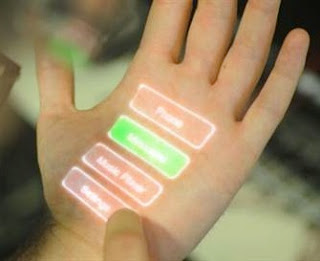
Quite a few of our pieces of code just didn't seem to want to integrate properly and while frustrating, it was a good learning experience of how the workflow of a project should go.
I think that the one limiting factor was my coding and it had a direct impact on how well we could port our ideas into reality.
I definitely would like to improve on my coding for the next project.

The main idea's were there and I was impressed by the new way of thinking we discovered.
What I mean by this is that, we tried to think of ways that we could use the natural motion of the body to produce output mapped to the movement, rather than trying to conform the body to use an 'interface' or perhaps use buttons to control the output.
Quite a few of our pieces of code just didn't seem to want to integrate properly and while frustrating, it was a good learning experience of how the workflow of a project should go.
I think that the one limiting factor was my coding and it had a direct impact on how well we could port our ideas into reality.
I definitely would like to improve on my coding for the next project.
Sunday, October 24, 2010
Week6- Growing the Flowers
We continued working on the project and further solidified the idea. We decided to begin piecing it all together, so the flower renders had to be made. I used Adobe After Effects to accomplish this and the results can be seen below.

This is one of the flowers, and then the second..

Once the renders were done, we decided to start working on the powerpoint and how we were going to present.
The criteria we had to touch base with was very clear, and we wanted to make sure to mention every point on the criteria list.
An important thing to note, is that as we went through the criteria, it got us thinking about different aspects of the project and we realized that we hadn't even thought of some things.
One such thing was the need to discuss the idea of embodiment within our project. We knew we had to have motion in our project, but we hadn't thought of how exactly we'd explain our project in terms of embodiment.

An important thing to note is that embodiment can be seen in many different forms.
Shown above is the embodiment of Mazda Motor Corporation's design philosophy "Zoom zoom"
Week5- Project Underway
We decided to pursue an interactive installation that would have the concepts of growing flowers as your body moved. The plan was to use color tracking to track the motion of the body part, in this case a hand, and then render out movies so that Max would call on them and play the movie to display the flower.


The main issue we foresee is that our group's way of thinking is just to use another button interface, meaning we're trying to convert the body into just being another button input. This was actually the wrong way of thinking about it.
After speaking with Greg we understood that instead we must try to utilize motion to get the desired output and steer away from the 'button' interface idea we've become accustomed to in our daily lives.
Just like this toaster, we had to steer clear of buttons :)

The coding for this seems to be a bit challenging. We learned how to work with movie files in class but for some reason the whole workflow of Max is a bit confusing to me. I guess I've never been much of a programmer. Even as a small child.


The main issue we foresee is that our group's way of thinking is just to use another button interface, meaning we're trying to convert the body into just being another button input. This was actually the wrong way of thinking about it.
After speaking with Greg we understood that instead we must try to utilize motion to get the desired output and steer away from the 'button' interface idea we've become accustomed to in our daily lives.
Just like this toaster, we had to steer clear of buttons :)
The coding for this seems to be a bit challenging. We learned how to work with movie files in class but for some reason the whole workflow of Max is a bit confusing to me. I guess I've never been much of a programmer. Even as a small child.

Week4- The Eye
“Unlike the human eye and brain, no computer vision algorithm is completely "general", which is to say, able to perform its intended function given any possible video input”

This week's lecture built was very technical and built upon the conceptual ideas in the readings.
The different positionings that were possible with the projectors were interesting because I had never thought about all the work that went into the actually physical set up of the examples we had seen.
What I found useful was that the readings actually related to the lecture material which helped me solidify my understanding of the concepts.
The author went through the different limitations of a computer system’s ‘vision’ and discussed how it’s still a major problem even today. It gave a good base of chronological advancement to show that it’s a hot topic even till this day.
Particularily interesting, was the explanation of how motion tracking actually worked.

The use of specific points on the screen usually given by pixels, are used to track the motion of the body that you choose to follow.
It was interesting to read about the different ways in which the human body can be tracked.“The mouth cavity is easily segmentable as a dark region, and the circularity of its shape is also closely linked to vowel sound. The pupils of the eye emit an easy-to-track infrared retroreflection, and they also indicate a person's direction of gaze.”
This also gave me ideas for the project, and how I might be able to track motion.
Subscribe to:
Posts (Atom)